
Because they partly are. Every spray perfume is built from a scent concentrate - the same class of material sold as fragrance oil - which is then diluted in denatured alcohol. Perfume oil skips the alcohol and stays in a carrier oil. Same scent chemistry, different delivery.
I get this question at least twice a week. Someone picks up a bottle, turns it over, and asks me straight out: "Is this the same stuff that's inside a designer bottle?"
After more than ten years selling oils, I've learned the people asking aren't confused. They're working with half the picture. Here's the other half.
What is a spray perfume actually made of?
A commercial spray perfume has two components: a scent concentrate and a carrier.
The concentrate is the fragrance itself - a blend of aroma compounds, some distilled from plants, some produced synthetically, usually both. Perfumers call this the compound or the juice. It's thick and far too strong to wear undiluted.
The carrier is what thins it so it sprays and spreads. In nearly every designer perfume sold in a department store, that carrier is denatured ethanol with a small amount of water.
So the scented material inside a spray bottle and the scented material inside a bottle of fragrance oil come from the same suppliers, the same aroma chemistry, the same accords. The difference isn't the scent. It's what's holding it.
Why does the mix-up happen so often?
Three things, and they've been muddying this for years.
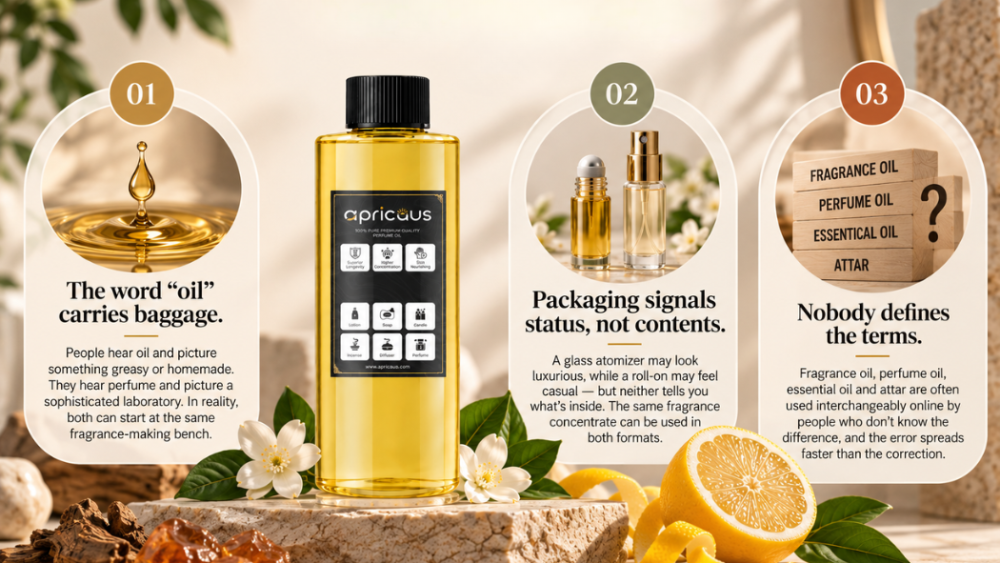
- The word "oil" carries baggage. People hear oil and picture something greasy or homemade. They hear perfume and picture a laboratory in Grasse. Both start at the same bench.
- Packaging signals status, not contents. A glass atomizer reads as luxury; a roll-on reads as casual. Neither tells you a thing about what's inside. I sell roll-on bottles and atomizers to the same small brands, filled with the same concentrate.
- Nobody defines the terms. Fragrance oil, perfume oil, essential oil and attar get swapped around online by people who don't know the difference, and the error spreads faster than the correction.
What's the difference between fragrance oil, perfume oil and essential oil?
- Essential oil - single plant, distilled or cold pressed, no carrier. Fades fast. Built for aromatherapy, not perfume.
- Fragrance oil - blended natural and synthetic aroma materials, sold as concentrate and often cut with DPG. What perfumes build from.
- Perfume oil / attar - concentrate at wearable strength in a carrier oil, no alcohol. Slow release, close to skin, long hours.
- Alcohol perfume - same concentrate in denatured ethanol and water. Bright opening, wide projection, shorter tail.
Four names. Two of them describe the same material at different stages.
One point worth stating plainly: there is no such thing as a fresh linen essential oil, or an oud that smells like sea spray. Plenty of scent profiles simply don't exist in nature, which is why fragrance oils exist at all. Traditional attars solve this differently, through centuries-old blending practice - that's the tradition our amber, oud and musk oils come out of. Single-botanical extractions live in a separate category entirely, which is what you'll find under essential oils.
Why does the same scent smell different as an oil?
Alcohol changes how a fragrance behaves, not what it is.
Ethanol evaporates off skin within a minute or two. It pushes the top notes outward fast, which is why a fresh spray fills a room. It also carries some of the lighter molecules away as it goes.
An oil doesn't evaporate like that. It sits on the skin and releases slowly as your body heat warms it. You give up the opening burst; you gain hours on the back end. That trade is the entire reason people who switch to oils rarely switch back.
It also explains projection. Oils sit closer to the body. Some people want to be noticed from across a room, others only at conversational distance. Neither is better - they're different jobs.
And there's the skin question. Alcohol is drying. If you deal with sensitive skin or eczema, a daily spray of it isn't helping. Alcohol-free removes that problem outright.
Are "designer type" oils the real thing?
No, and any seller who tells you otherwise is lying to you.
An oil described as inspired by or compared to a designer scent is a house interpretation of a well-known profile. It isn't the brand's product and isn't bottled by the brand. What a good interpretation does is read that accord closely using the same families of aroma material.
Quality varies enormously. It comes down to who's blending and what grade of material they use. Our top selling oils earned that spot through reorders, which is the only endorsement I trust.
Which should you buy?
Stop treating oils as a downgrade. They're a different format of the same craft.
Want longevity and quiet, close wear? Go with an oil - start with men's fragrance oils or women's perfume oils, though plenty of my customers ignore those labels and shop across both.
Want projection and a bright opening? A spray suits you better.
Blending your own? You'll need DPG to bring your concentrate down to wearable strength. That's the step beginners skip, and it's why the first batch always comes out overwhelming.
FAQs
Q.1. Is perfume oil the same as fragrance oil?
Not quite. Fragrance oil is the concentrate perfumers blend with. Perfume oil is that concentrate brought down to a strength you can wear directly on skin. Same material, different dilution.
Q.2. Do perfume oils last longer than sprays?
Usually, yes. Without alcohol to flash off, the scent releases slowly from the skin over several hours. You trade the sharp opening burst for a longer wear time.
Q.3. Can you put fragrance oil directly on your skin?
Only if it's sold as skin-safe and at a wearable strength. Undiluted concentrate is far too strong. Check that it's cosmetic-grade and phthalate-free before applying it.
Q.4. Are fragrance oils natural?
Some components are, some aren't. Most blends mix natural isolates with synthetic aroma materials, because many scent profiles can't be extracted from a plant at all. Single-source extractions are sold as essential oils instead.
Q.5. Why is there no alcohol in perfume oils?
Alcohol is a carrier, not a fragrance. Leaving it out means slower evaporation, longer wear, and no drying effect on skin - which matters if yours is sensitive.